

Turning lifetimes into legacies
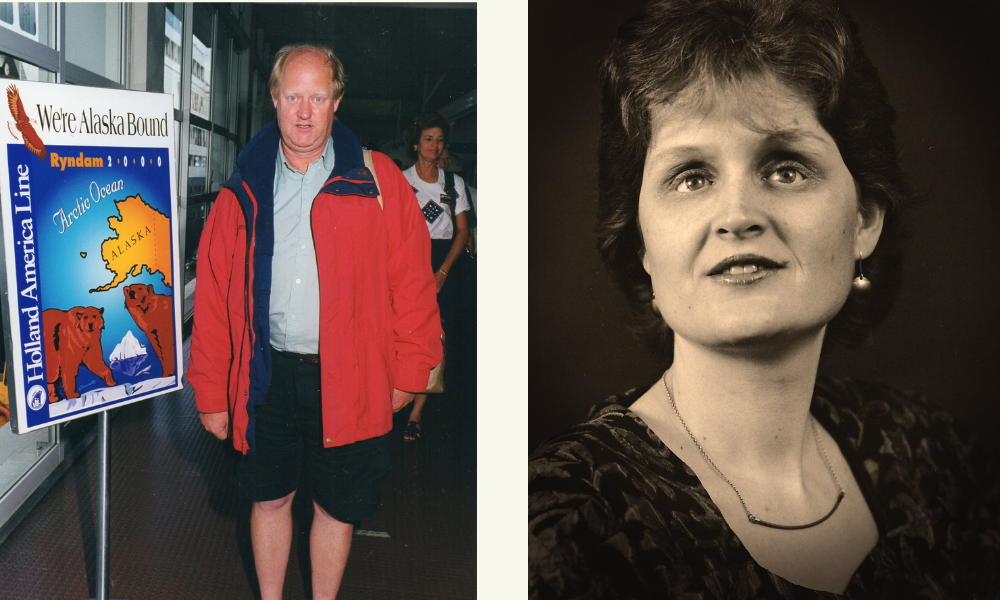
Morris Moller (left) and Lisette Wesseling (right).
Neatly stored in a garage are fragments of a life well lived. Worn-in tramping boots, still muddied from trips to the Ōrongorongo Range, stacks of dutifully collected DVDs, a yellow satin shirt for square dancing, passports stamped from trips to Oslo, Alaska and McMurdo Sound, ski poles and piles of dusty, yellowing photos.
Their owner, Morris Moller, was born in 1948 in Wellington to Ruth (nee Morris) and George Moller. His childhood was split between Aro Valley (and later Northland) and the family’s bach in Raumati, to which he fondly referred as the “country estate”. Morris’s passion for adventure was sparked early, taking part in Sea Scouts, Venturers and Rover Scouts from a young age.
An interest in heavy machinery was also ignited early. “Morris was always obsessed with buses, trams and trains!” says cousin Catherine Ellicock. This interest was something Morris explored in both his personal and professional life. He was a long-time member of New Zealand’s Omnibus Society, holding the role of Treasurer, attending conferences, managing memberships of fellow enthusiasts and volunteering his time to drive charter buses. Fellow society member Henry Brittain KSM fondly remembers Morris’s comprehensive and neatly compiled records of bus fleets. “He would have had every single fleet in New Zealand!”
Morris’s career was spent in the driver’s seat – as a truck driver for Adams and Blyth Limited in the 1970s, where he helped with large local infrastructure projects such as the Bolton Street motorway bisection, and then as a bus driver for Stagecoach. For over 26 years, Morris had quietly donated to Wellington Free Ambulance. It was fitting, therefore, that this support would continue even after Morris passed away. Having always aspired to purchase an ambulance, Nīkau and the executors of Morris’s estate agreed to realise this dream, providing a gift for Wellington Free Ambulance to purchase a bespoke Mercedes Sprinter Ambulance while establishing the Morris Moller Fund.
Dedicated to supporting the health and wellbeing of our communities through emergency care and rescue services, the fund will ensure that the causes Morris loved receive a donation every year, forever.
Passing on the baton
Against Wellington Cathedral’s lofty ceiling echo the notes of Monteverdi’s Vespers of the Blessed Virgin. In the stalls below stands a chorister adorned in crimson robes, hands drifting across a braille music sheet. Her name is Lisette.
Born in 1971 as Elizabeth Jacoba Maria Wesseling, Lisette was blind from a very early age, having developed retinoblastoma as a baby. After spending her early childhood in the Netherlands, her family emigrated to New Zealand in 1980, with her parents establishing a bakery in Manurewa. From a young age, she loved singing and showed potential early. She went on to study music at both Auckland and Melbourne Universities, before travelling to London to complete her postgraduate studies at the Guildhall School of Music and Drama under the tutelage of Dame Emma Kirkby.
Lisette’s time in London would be formative as she pursued performance opportunities with, among others, the Sweelinck and Sienna Ensembles, tried her hand at teaching and met her husband Neil. Throughout her career, her voice was described as a force that could “move a stone to tears … [through its] piercing ethereal clarity”. She was well regarded by audience members and critics alike. “Few sopranos in this country could dispense roulades of notes with the grace and effortlessness [Lisette] epitomised,” noted William Dart in his 2005 Bach Musica New Zealand Herald write-up.
While Aotearoa New Zealand called Lisette home in 2004, she continued to build an impressive musical career. Lisette held the belief that the arts were essential. “To her, singing wasn’t just a job,” says Neil. “It was something that was crucial to life.” She aimed to instil the same passion for the singing craft in younger generations, teaching hundreds of students to express themselves through the medium.
Lisette was also a keen advocate for blind people, encouraging many to live their lives without limits. She published a book of braille music to help individuals pursue their musical passions and advocated for the use of braille in public settings in her position as a Braille Awareness Consultant at Blind Low Vision New Zealand. She amassed “probably the largest” collection of braille sheet music in Aotearoa New Zealand, was instrumental in introducing braille books into libraries across the country and even visited Paris to celebrate the 200-year anniversary of Louis Braille’s birthday.
Lisette sadly passed away at the age of 44 in 2016 after the cancer she developed in childhood returned. Following her passing, Neil wanted to find a way to preserve her memory. While Lisette’s spellbinding renditions of La Manfredina, Amoroso and Salterello can continue to be experienced through her 2003 CD Songs from the Taverne, Neil also wanted to make sure that contemporaries could continue to gain inspiration and experience in Lisette’s memory. Nīkau Foundation’s Lisette Wesseling Blind Musicians Fund will ensure that other blind or low vision musicians can pursue their ambitions.“Lisette’s fund is a way to pass on the baton so that many, many others continue to find joy in music and pursue their passions without barriers.”
During their lifetimes, Lisette and Morris left their own indelible marks on the world. Through their respective funds, they will continue to leave a mark on the hearts of future generations and make a difference for the causes they loved, forever.
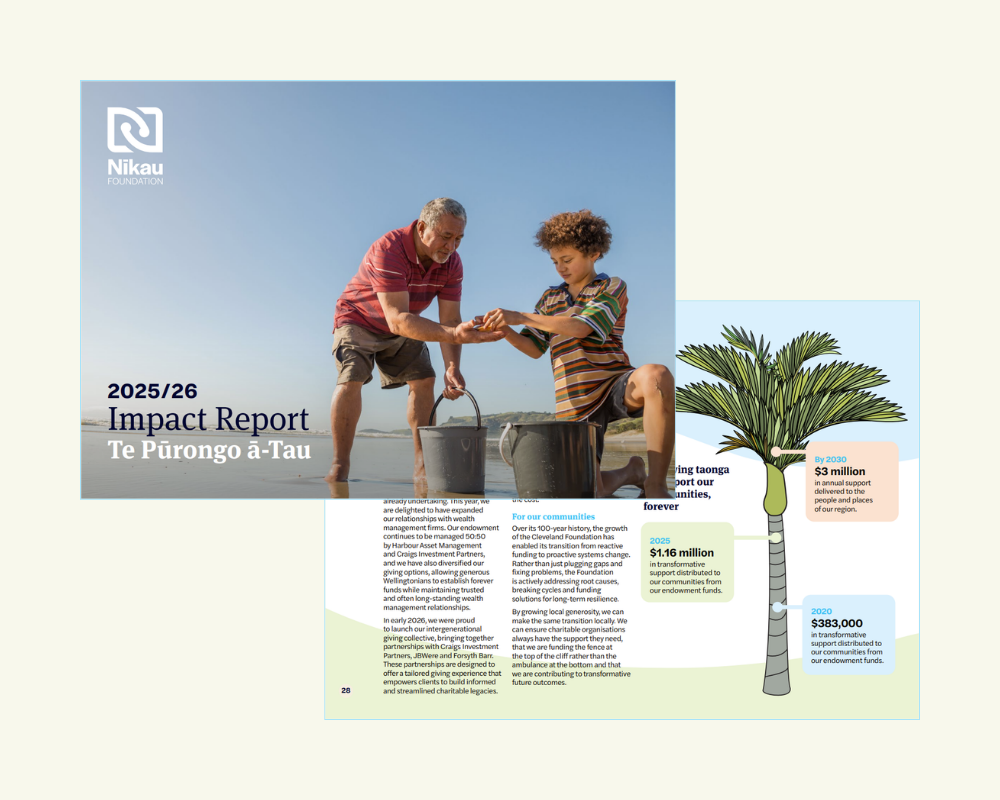
Download our 2025/26 Impact Report
This report, which covers the period from October 2024 - March 2026, features stories of grassroots action across our communities, organisations doing amazing mahi to support the people and places of our region and generous locals, who are leaving transformative legacies for the causes they love. To download, please click below.